


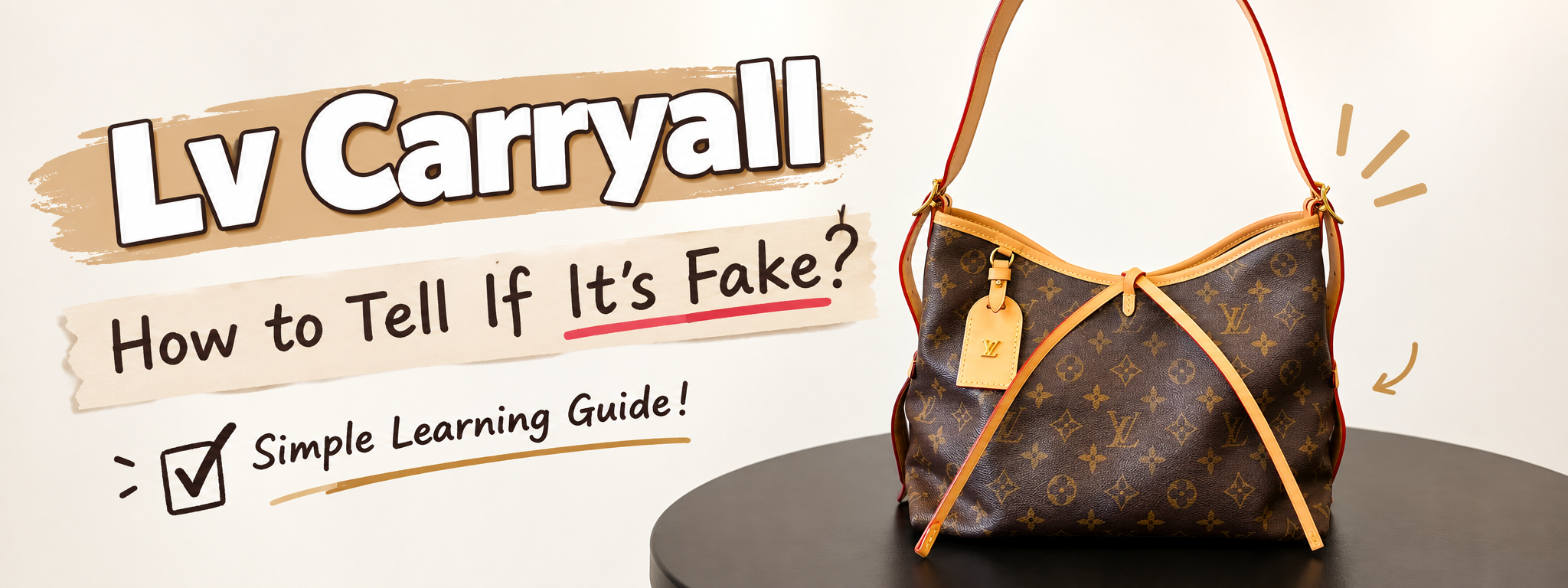
How Can You Tell If a LV Bag Is Fake? A Complete Louis Vuitton Authentication Guide
Louis Vuitton bags are known for their distinctive Monogram canvas, carefully finished leather, recognizable hardware, and precise construction. Because of these characteristics, many people wonder: how can you tell if a LV bag is fake?
Authenticating a Louis Vuitton bag requires looking at multiple details rather than relying on one particular feature. The canvas pattern, leather, stitching, hardware, interior construction, shape, dimensions, and overall finishing should all be considered together.
This guide explains the main details to examine when comparing a Louis Vuitton bag with an authentic reference.
Quick Guide: How to Tell If a Louis Vuitton Bag Is Fake
Before examining every detail, here are the main areas to check:
- Model and dimensions
- Monogram canvas
- Leather quality
- Stitching
- Hardware
- Interior construction
- Logo and markings
- Overall shape
- Construction details
- Provenance and purchase history
No single characteristic should be used as definitive proof. Instead, look for consistency across multiple areas.
1. Identify the Exact Louis Vuitton Model
The first step is to identify the exact model.
Different Louis Vuitton bags have different:
- Dimensions
- Canvas patterns
- Handle construction
- Hardware
- Interior layouts
- Pocket configurations
- Strap designs
- Leather components
For example, a Louis Vuitton CarryAll has its own specific construction and proportions. Comparing it with photographs of another Louis Vuitton model can lead to incorrect conclusions.
Before examining authenticity, make sure you are comparing the item with the correct model and version.
2. Examine the Monogram Canvas
Louis Vuitton’s Monogram canvas is one of the most recognizable elements of its bags.
When examining the canvas, look at:
- Pattern placement
- Symbol proportions
- Color
- Texture
- Printing quality
- Alignment around seams
- Alignment around pockets and leather panels
The pattern should be considered together with the construction of the bag.
Instead of simply asking whether the Monogram “looks right,” compare how the pattern interacts with the bag’s seams, edges, pockets, and overall structure.
What to Look For
Pay particular attention to areas where the canvas meets another component.
For example:
Canvas → seam → leather trim → hardware
These elements should form a consistent overall construction.
3. Check the Leather
Leather is another important area to inspect.
Depending on the model, Louis Vuitton bags may use leather for:
- Handles
- Straps
- Trims
- Tabs
- Corners
- Decorative elements
Look at:
- Leather texture
- Thickness
- Color
- Edge finishing
- Stitching
- Surface consistency
Natural leather can change over time because of use, exposure to light, humidity, and oxidation.
Therefore, differences in leather color alone should not automatically be interpreted as evidence of a fake.
4. Examine the Stitching
Stitching is one of the easiest construction details to inspect visually.
Look at:
- Stitch spacing
- Stitch direction
- Thread thickness
- Thread color
- Tension
- Corner stitching
- Alignment
The important thing is consistency.
Compare corresponding areas of the bag rather than judging one isolated stitch.
For example, examine stitching around:
- Handles
- Leather tabs
- Straps
- Pockets
- Corners
- Edges
Irregular spacing, inconsistent tension, or unusual finishing may warrant further examination.
5. Inspect the Hardware
Hardware should be examined carefully.
Look at:
- Color
- Shape
- Surface finish
- Engraving
- Edges
- Attachment points
- Zipper construction
Compare multiple pieces of hardware on the same bag.
For example, if the bag contains several gold-tone components, check whether their finish and color appear consistent.
Lighting can significantly affect how metallic hardware appears in photographs, so hardware color alone should not be treated as conclusive.
6. Examine the Interior
The inside of a Louis Vuitton bag can provide additional information.
Depending on the model, examine:
- Lining
- Interior pockets
- Leather tabs
- Zippers
- Snaps
- Stitching
- Embossing
- Construction of compartments
For models such as the CarryAll, the interior layout and construction should be compared with reliable references for the same model and production version.
7. Check the Logo and Markings
Louis Vuitton logos and embossed markings should be examined for:
- Letter spacing
- Font proportions
- Alignment
- Embossing depth
- Position
- Overall clarity
However, markings should not be used in isolation.
Modern counterfeit products can reproduce individual logos and markings, so it is more useful to evaluate them together with the bag’s construction, materials, and other details.
8. Check the Dimensions
Dimensions are particularly useful when authenticating a specific model.
Measure:
- Length
- Height
- Width
- Handle drop
- Strap length where applicable
Compare the measurements with official or otherwise reliable references for the same model and version.
Small differences can sometimes occur because of:
- Measurement technique
- Bag contents
- Material flexibility
- Manufacturing tolerances
- Age and use
Therefore, dimensions should be treated as one part of the overall assessment.
9. Examine the Overall Shape
Look at the bag from several angles:
- Front
- Back
- Side
- Bottom
- Top
- Interior
Pay attention to:
- Proportions
- Symmetry
- Base shape
- Side profile
- Handle position
- Strap angle
- Structure
A bag can have convincing individual details while still having differences in its overall proportions.
Real vs Fake: What Are the Main Differences?
When comparing an authentic Louis Vuitton bag with a counterfeit, it is useful to look at the combination of details rather than searching for a single “fake sign.”
| Detail | What to Examine |
|---|---|
| Canvas | Pattern, texture, color and alignment |
| Leather | Texture, color, thickness and finishing |
| Stitching | Spacing, tension and alignment |
| Hardware | Shape, finish and color |
| Interior | Construction and materials |
| Logo | Font, spacing and embossing |
| Dimensions | Model-specific measurements |
| Shape | Overall proportions and structure |
| Finishing | Consistency throughout the bag |
Real vs High Fake vs Low Fake
When comparing bags, you may also come across the terms Real, High Fake, and Low Fake.
These are informal marketplace terms rather than official Louis Vuitton classifications. They generally describe perceived differences in the overall quality of a counterfeit item.
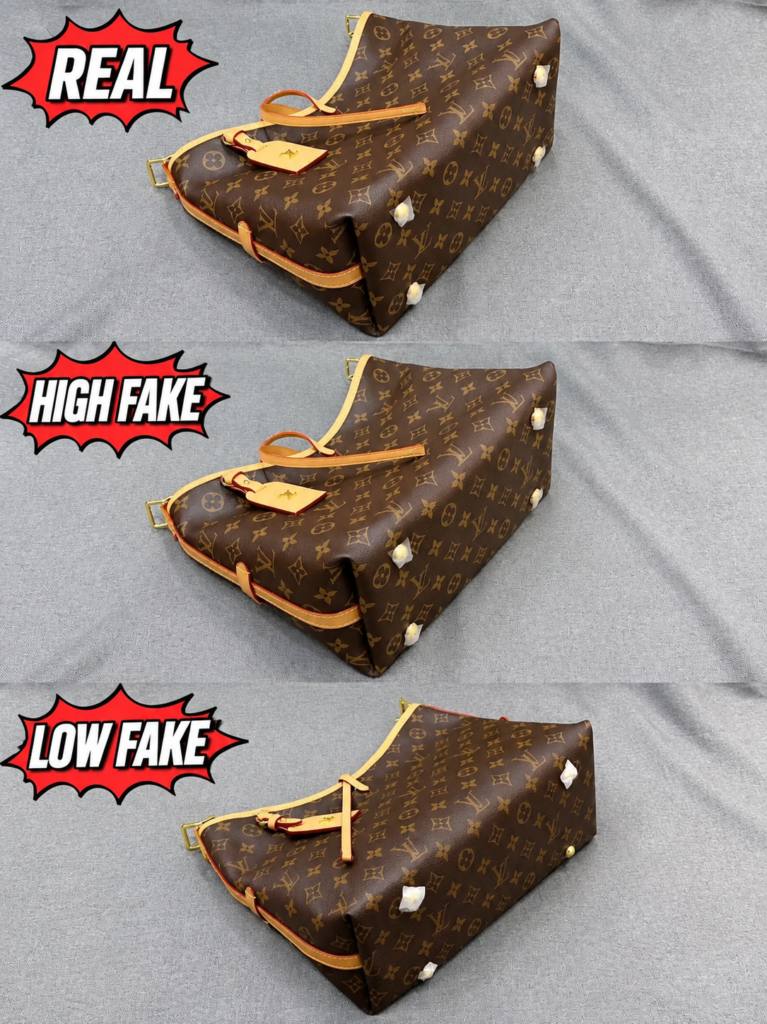
| Feature | Real | High Fake | Low Fake |
|---|---|---|---|
| Overall construction | Consistent with the authentic product | Attempts to closely reproduce the original | More obvious deviations may appear |
| Canvas | Consistent pattern, texture and finishing | Often visually similar | Pattern or texture may show more noticeable differences |
| Stitching | Consistent spacing and tension | Generally attempts to reproduce the same appearance | Irregularities may be easier to see |
| Hardware | Consistent shape and finishing | May closely imitate the appearance | Shape or finishing may differ more noticeably |
| Leather | Consistent materials and finishing | Attempts to reproduce the appearance | Texture, color or finishing may differ |
| Shape | Model-specific proportions | Often attempts to reproduce the same silhouette | Proportions may be less accurate |
| Interior | Consistent construction | Can appear similar in photographs | Differences may be more apparent |
| Overall details | Multiple elements work together consistently | Many individual details may look convincing | Multiple inconsistencies may be visible |
Why the Difference Matters
A high fake may reproduce many individual visual characteristics convincingly. As a result, simply looking at a photograph may not be enough to distinguish it from an authentic product.
A low fake may have more visible inconsistencies across several areas, such as stitching, hardware, proportions, materials, or finishing.
An authentic product should be evaluated based on the consistency of the entire construction, rather than one isolated characteristic.
Important: “High Fake” and “Low Fake” are descriptive terms commonly used in the replica/counterfeit market. They are not official categories used by Louis Vuitton.
10. Common Red Flags
Here are some areas that deserve additional attention:
1. Incorrect proportions
The overall silhouette doesn’t correspond closely with the documented model.
2. Inconsistent stitching
Spacing or tension varies noticeably between corresponding areas.
3. Unusual hardware
Hardware shape, finish, or engraving appears inconsistent.
4. Poor edge finishing
Leather edges may appear rough, uneven, or inconsistent.
5. Incorrect canvas alignment
Pattern placement doesn’t correspond with the construction of the bag.
6. Interior differences
Pocket placement, lining, hardware, or construction differs from reliable references.
7. Multiple inconsistencies
Several independent details appear inconsistent at the same time.
The last point is particularly important: multiple independent inconsistencies are generally more informative than one isolated difference.
How to Authenticate a Louis Vuitton Bag Step by Step
For a practical inspection, follow this sequence:
Step 1: Identify the Model
Determine the exact model and version.
Step 2: Check Dimensions
Measure the bag and compare it with reliable specifications.
Step 3: Examine the Canvas
Look at pattern placement, texture, color, and alignment.
Step 4: Examine the Leather
Check texture, color, thickness, edges, and finishing.
Step 5: Inspect the Stitching
Compare stitch spacing, tension, and alignment.
Step 6: Inspect the Hardware
Look at hardware shape, finish, engraving, and attachment.
Step 7: Check the Interior
Compare the lining, pockets, tabs, zippers, and other interior components.
Step 8: Examine the Overall Shape
Compare the complete silhouette from multiple angles.
Step 9: Review Provenance
Consider the seller, purchase history, documentation, and transaction information.
Step 10: Consider Professional Authentication
For a high-value purchase, an independent professional authentication service can provide additional verification.
Louis Vuitton CarryAll: What Should You Check?
The CarryAll is a useful example because its authenticity can be examined through several different components.
When checking a CarryAll, pay attention to:
- Monogram canvas
- Canvas alignment
- Leather trim
- Handles
- Stitching
- Hardware
- Interior
- Removable pouch where applicable
- Overall dimensions
- Side profile
- Bottom construction
Rather than focusing on one detail, compare the complete construction against reliable references of the same CarryAll model.
Frequently Asked Questions
Can you tell if a Louis Vuitton bag is fake from one photo?
Usually, a single photograph is not enough to establish authenticity with confidence.
Multiple photographs showing the canvas, stitching, hardware, interior, logo, dimensions, and overall structure provide much more information.
Is a high fake difficult to identify?
A higher-quality counterfeit may reproduce many visual characteristics of an authentic product, making visual comparison more difficult.
This is why examining several independent details is more useful than relying on one feature.
Is a low fake easier to identify?
Lower-quality counterfeit products may have more visible differences in materials, construction, proportions, stitching, hardware, or finishing.
However, the exact differences vary between products.
Does perfect stitching mean a bag is authentic?
No.
Stitching is only one component of authentication. Other factors such as canvas, leather, hardware, construction, dimensions, and provenance should also be considered.
Can the date code prove authenticity?
No single code or marking should be treated as definitive proof of authenticity.
Louis Vuitton’s identification systems have changed over time, so the relevant details depend on the model and production period.
Final Checklist
Before deciding whether a Louis Vuitton bag appears authentic, review:
- Correct model
- Correct dimensions
- Canvas pattern
- Canvas texture
- Leather quality
- Edge finishing
- Stitching
- Hardware
- Logo and markings
- Interior construction
- Overall shape
- Provenance
- Multiple independent details
The most important principle is simple:
Don’t authenticate a Louis Vuitton bag based on one detail. Look at the entire product and evaluate whether all of its characteristics are consistent with the same authentic model and production version.
This approach also helps explain the practical distinction people often make between Real, High Fake, and Low Fake: the comparison is ultimately about how consistently the entire product reproduces the documented characteristics of the authentic item, rather than whether one particular detail looks correct.
Leave a Reply